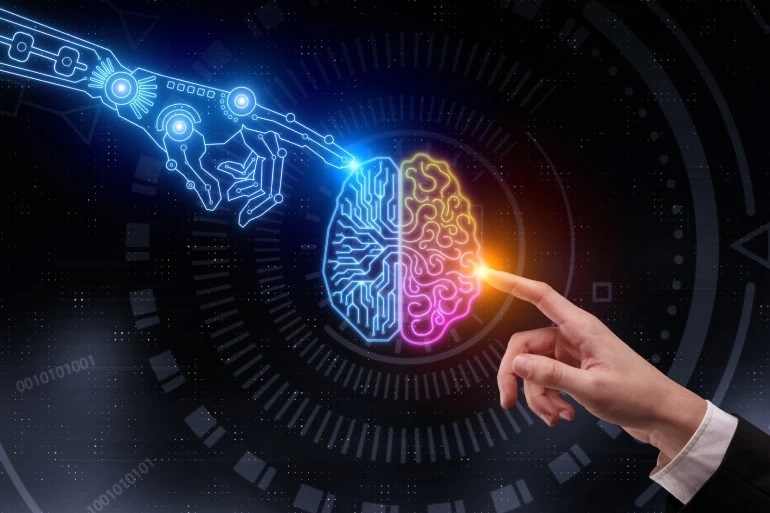

There is a hype around artificial intelligence (AI) for many years already and it has gotten another boost with the announcement of AI being able to write text on its own. How good such AI-written texts are and how the marketing industry can benefit from this technological innovation is, however, still questionable.
The fact is that AI can imitate human thinking to eventually be able to automatically take over tasks such as problem solving and decision making. A good example here is GPT-3, an intelligent language processing model launched by OpenAI in 2020, on which many copywriting tools are based. GPT-3 also uses machine learning (ML) and deep learning (DL) to train and learn. Machine learning is based on the concept that the machine can perform tasks without human instruction: it analyzes data, recognizes a pattern, learns from it and then applies that to new content, just like we learned theories in school and then applied them to new tasks. Deep learning is about the neural network of the machine, in other words “the brain”. GPT-3’s “brain” is based on 175 million synapses, making it the largest computational linguistics transformer that comes closest to the human brain of any AI technology. The human brain is of course still vastly superior with 125 trillion synapses, but it can be expected that technology will continue catching up.
Artificial intelligence in marketing
Anyway, the use of AI in marketing is still in its infancy and not yet very widespread. That said, some companies are just figuring out what AI is all about and how it can benefit marketing, while others are implementing and testing. However, statistics show that the number of companies using AI is increasing. The reason for this is simply that higher profits can be achieved with it. Many experts predict...


Subscribe to Continue Reading
Get exclusive AI insights for marketers and business leaders - newsletters, strategies, and expert tips included.